

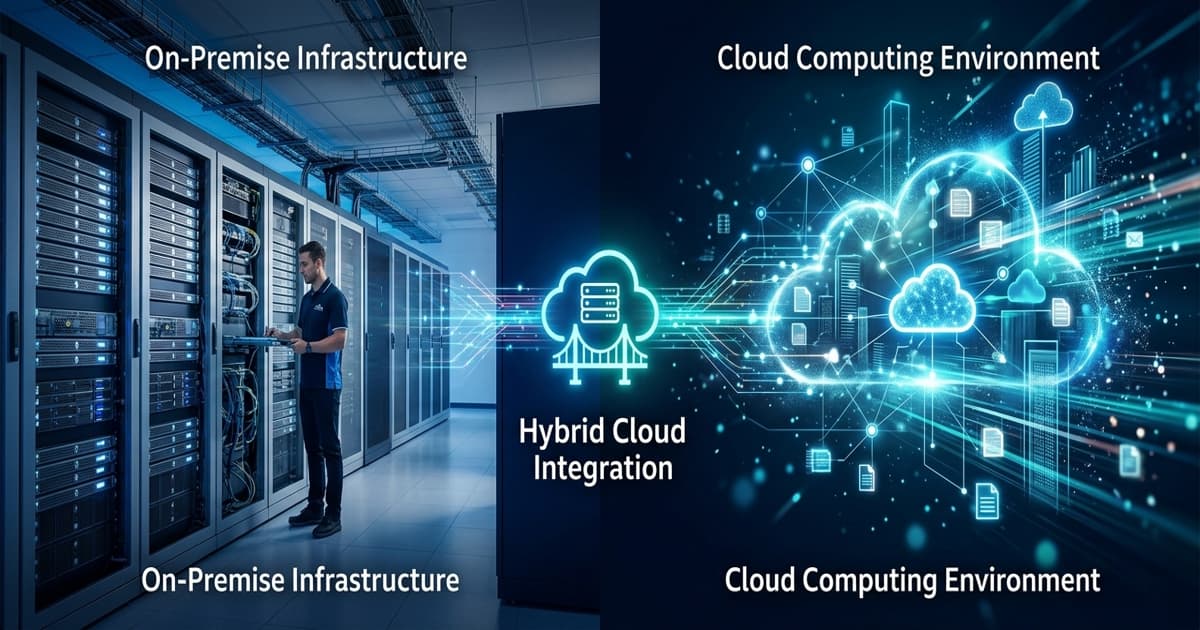
Discover the key differences between cloud solutions and on-premise infrastructure in 2026. Compare cost, security, scalability, compliance, and performance to choose the right IT infrastructure for your business.
In 2026, cloud solutions are reshaping how businesses think about IT infrastructure. Yet on-premise systems remain critical for many organisations. The decision is no longer a simple technology preference. It is a strategic business choice that affects costs, security, compliance, scalability, and long-term growth. According to Gartner, worldwide public cloud end-user spending is forecast to reach approximately $723.4 billion in 2025, confirming that cloud adoption continues to accelerate globally. This article compares both infrastructure models across key dimensions and explains why many organisations are now adopting hybrid approaches to get the best of both worlds. Explore how enterprise networking solutions can form the connectivity backbone that supports both cloud and on-premise environments.
Key Takeaways
• Cloud solutions offer faster scalability, remote access, and reduced hardware dependency, making them ideal for organisations with dynamic workloads and growth ambitions.
• On-premise infrastructure provides greater control, predictable performance, and is better suited for workloads with strict data sovereignty or compliance requirements.
• Many organisations in 2026 are adopting hybrid cloud infrastructure solutions to balance flexibility with control, optimising costs while maintaining security over sensitive data.
What Is the Difference Between Cloud and On-Premise Infrastructure?
Understanding the core difference between these two models is the starting point for any infrastructure decision. Both approaches serve different operational needs, and neither is universally superior. Businesses across the UAE are evaluating these models as part of broader digital transformation strategies, and working with specialists in structured cabling infrastructure is often the first step toward building a reliable physical network foundation for any deployment model.
What Are Cloud Solutions?
Cloud solutions provide access to computing resources, storage, databases, networking, and software delivered over the internet through third-party providers such as AWS, Microsoft Azure, or Google Cloud. According to NIST's definition of cloud computing, cloud infrastructure is characterised by on-demand self-service, broad network access, resource pooling, rapid elasticity, and measured service. Businesses pay for what they use, scaling resources up or down based on demand. This makes cloud services particularly attractive for organisations with variable or unpredictable workloads.
What Is On-Premise Infrastructure?
On-premise infrastructure refers to hardware, servers, and software systems that organisations own, operate, and manage within their own physical facilities. Businesses retain full control over their data environment, network configuration, and security policies. This model requires significant upfront capital investment in server solutions and ongoing maintenance. However, it provides direct control over performance, customisation, and data governance. Industries with strict regulatory requirements often prefer on-premise systems to maintain full data sovereignty. Organisations managing physical infrastructure can also benefit from reviewing annual maintenance contract services to keep hardware environments operational and well-supported.
Understanding the Hybrid Cloud Approach
Hybrid cloud infrastructure combines elements of both cloud and on-premise environments. Organisations use private cloud or on-premise systems for sensitive or specialised workloads while leveraging public cloud platforms for scalable applications, disaster recovery, analytics, and collaboration. This model is increasingly popular across industries as it allows businesses to optimise infrastructure costs without compromising control.
Cloud Solutions vs On-Premise Infrastructure: Key Differences
Comparing these two models across specific business and operational criteria reveals why the decision is nuanced and highly context-dependent.
Cost and Total Cost of Ownership
Cloud storage services typically operate on an operational expenditure model, eliminating large upfront capital investments. However, costs can escalate with growing usage. Flexera's 2025 State of the Cloud Report found that 84% of organisations identify managing cloud spend as a top challenge. On-premise infrastructure requires higher initial investment in hardware and facilities but can be more cost-effective over time for predictable, steady-state workloads. Businesses should evaluate total cost of ownership across a three to five year period rather than comparing upfront costs alone.
Scalability and Flexibility
Cloud solutions for small businesses in UAE and large enterprises alike benefit from near-instant scalability. Cloud platforms allow organisations to provision additional compute, memory, or storage solutions Dubai businesses rely on within minutes. On-premise infrastructure requires physical procurement, installation, and configuration, which can take weeks or months. For businesses experiencing rapid growth, seasonal demand spikes, or unpredictable usage patterns, cloud platforms offer a significant operational advantage. Connectivity quality is equally important, and businesses relying on IP telephony and communication services must ensure their network infrastructure can support the bandwidth demands of cloud platforms.
Security and Data Protection
Security is one of the most debated aspects of the cloud versus on-premise comparison. Cloud providers invest heavily in physical security, certifications, and threat detection. However, Microsoft's shared responsibility model makes clear that security responsibility is divided between the cloud provider and the customer, varying by service type. Customers remain responsible for identity management, data classification, access controls, and application security. On-premise infrastructure gives organisations full control over their security posture but requires internal expertise and investment to maintain it effectively.
Performance and Reliability
On-premise systems can offer lower latency and more predictable performance for workloads that require real time processing or access to local data. Cloud performance depends on internet connectivity and shared infrastructure. Leading cloud providers now offer service level agreements with high availability guarantees, but latency-sensitive applications may still perform better on dedicated on-premise hardware. Data center solutions that combine local processing with cloud connectivity can address performance requirements in specific scenarios. Businesses seeking reliable local connectivity should also explore how video conferencing solutions integrate with both cloud and on-premise communication infrastructure.
Maintenance and IT Management
On-premise infrastructure places the full burden of hardware maintenance, software patching, capacity planning, and system upgrades on internal IT teams. Cloud providers handle most infrastructure layer maintenance, allowing internal teams to focus on application development, security governance, and business outcomes. For organisations with limited IT resources, cloud platforms reduce operational complexity significantly.
Business Continuity and Disaster Recovery
Cloud platforms provide built-in redundancy, geographic distribution, and backup capabilities that can significantly strengthen business continuity. Cloud disaster recovery solutions are generally faster to deploy and more cost-effective than traditional on-premise replication. On-premise disaster recovery requires separate hardware, off-site backup facilities, and regular testing. For most businesses, cloud infrastructure offers a more accessible and scalable approach to business continuity planning.
Compliance and Data Control
Organisations operating in regulated industries such as healthcare, finance, or government may face strict data residency requirements that restrict where data can be stored and processed. Some compliance frameworks require complete data sovereignty, making on-premise or private cloud deployments preferable. Cloud storage services for enterprises operating in the UAE must evaluate compliance with local data protection regulations and sector-specific requirements before committing to a cloud migration strategy.
Advantages of Cloud Solutions in 2026
The advantages of cloud services in Dubai and globally continue to grow as cloud technology matures. Key benefits include:
• Faster scalability: Instantly scale compute and storage resources to match business demand without hardware procurement delays.
• Flexible resource allocation: Pay only for the resources your organisation consumes, adjusting allocations as workloads change.
• Remote accessibility: Enable distributed teams and remote workers to access systems and data from any location securely.
• Faster deployment: Launch new applications and services in hours rather than weeks, accelerating time to market.
• Reduced hardware dependency: Eliminate the capital investment and physical management of on-premise server infrastructure.
• Access to advanced cloud technologies: Leverage built-in AI, analytics, machine learning, and automation tools from cloud platforms.
• Easier backup and disaster recovery: Implement automated, geographically redundant backup and recovery strategies at a fraction of traditional costs.
When Does On-Premise Infrastructure Make More Sense?
Despite the growth of cloud adoption, on-premise infrastructure remains the right choice in several scenarios.
Strict Data Control and Compliance Requirements
Organisations that must maintain complete control over where data is stored and processed should carefully evaluate whether cloud deployments can meet their regulatory obligations. Industries such as defence, healthcare, and certain financial services may have requirements that are more easily satisfied by on-premise or private cloud environments. Organisations in these sectors can also explore how physical access control systems complement digital security strategies across on-premise data environments.
Legacy Applications and Specialised Workloads
Many organisations operate legacy applications that were not designed for cloud environments. Migrating these systems can be costly and complex without significant application modernisation. Similarly, workloads that rely on specialised hardware, proprietary operating systems, or tightly integrated data environments may be better served by dedicated on-premise infrastructure.
Predictable Workloads and Long-Term Infrastructure Needs
For organisations with stable, predictable computing requirements, on-premise infrastructure can offer a lower total cost of ownership over a multi-year period. Fixed workloads that do not require dynamic scaling may not benefit significantly from cloud elasticity, making the capital investment in dedicated hardware financially justified.
Performance and Customisation Requirements
Certain applications such as high frequency trading platforms, real time manufacturing systems, or graphics intensive workloads may require the dedicated performance and customisation that on-premise hardware provides. Cloud shared infrastructure may introduce latency or performance variability that is unacceptable for these use cases.
Why Hybrid Cloud Solutions Are Becoming More Popular
Hybrid cloud infrastructure solutions are now the preferred approach for a growing number of organisations. Rather than choosing exclusively between cloud and on-premise, businesses are combining both environments to achieve operational flexibility without sacrificing control.
• Balancing flexibility with control: Run sensitive workloads on-premise while leveraging cloud for scalable applications and collaboration.
• Supporting sensitive workloads: Keep regulated or confidential data within controlled on-premise environments while benefiting from cloud capabilities elsewhere.
• Improving business continuity: Use cloud backup and disaster recovery to complement on-premise primary systems.
• Managing legacy applications: Maintain legacy systems on-premise while modernising new applications in cloud environments gradually.
• Optimising infrastructure costs: Avoid over-provisioning on-premise resources by extending capacity to the cloud during peak demand periods.
• Supporting gradual cloud migration: Move workloads to the cloud incrementally rather than executing a high-risk complete migration in a single phase.
Cloud vs On-Premise: Which Is More Secure?
Security is rarely a clear winner in the cloud versus on-premise comparison. Both models present unique security challenges and opportunities.
Cloud Security Responsibilities
Cloud providers invest billions in physical security, infrastructure layer protection, compliance certifications, and threat intelligence. However, customers retain responsibility for identity and access management, data encryption, network security configurations, and application level protections. Organisations that do not properly configure these controls face significant cloud security risks regardless of the provider's underlying security investments.
On-Premise Security Responsibilities
On-premise infrastructure gives organisations complete control over their security environment. However, this also means that the organisation bears full responsibility for physical security, perimeter protection, patch management, intrusion detection, and incident response. Smaller organisations without dedicated security teams may struggle to maintain the same level of protection that major cloud providers deliver at scale. Businesses can complement on-premise security with CCTV surveillance solutions to protect physical data center environments and sensitive infrastructure facilities.
Why Security Depends on Implementation
In both models, security outcomes depend primarily on implementation quality, governance policies, and the expertise of the teams managing the environment. A well-configured cloud deployment can be more secure than a poorly maintained on-premise system, and vice versa. Organisations should evaluate their internal security capabilities honestly when choosing between these infrastructure models.
How to Choose the Right Infrastructure for Your Business
Choosing between cloud solutions, on-premise, or hybrid infrastructure requires a structured evaluation of your organisation's specific requirements. Consider the following factors:
• Business size and growth plans: Rapidly growing organisations benefit from cloud elasticity, while stable businesses may prefer on-premise predictability.
• Workload requirements: Identify whether your workloads require real time processing, dynamic scaling, or specialised hardware.
• Data sensitivity: Classify your data and determine which workloads can reside in shared cloud environments and which require isolation.
• Compliance and regulatory needs: Understand your industry's data residency and security obligations before selecting a deployment model.
• Budget and total cost of ownership: Model costs over three to five years, including infrastructure, licensing, staffing, and management overhead.
• Internal IT capabilities: Assess whether your team has the expertise to manage on-premise infrastructure or would benefit from cloud managed services.
• Scalability requirements: Determine whether your workloads are predictable or variable to assess the value of cloud elasticity.
• Business continuity needs: Evaluate your recovery time and recovery point objectives to identify the most suitable continuity architecture.
Should Your Business Move to the Cloud in 2026?
Cloud migration is not a decision that fits every organisation the same way. Businesses should approach migration as a structured process rather than a blanket technology shift.
Assess Your Existing IT Environment
Begin with a detailed inventory of your current infrastructure, applications, and data environments. Identify dependencies, performance requirements, compliance constraints, and legacy system limitations that may affect migration feasibility. For a broader view of how technology decisions connect across your organisation, explore the project portfolio and case studies that demonstrate how businesses have successfully deployed enterprise IT infrastructure.
Identify Cloud-Ready Workloads
Not every workload is equally suited for cloud migration. Prioritise applications that are loosely coupled, stateless, or already designed for distributed environments. Legacy or tightly integrated applications may require modernisation before migration is practical.
Calculate the Total Cost of Migration
Business cloud migration services should include a detailed cost model that accounts for data transfer fees, application refactoring, retraining, downtime risk, and ongoing cloud management costs. Many organisations underestimate migration costs, leading to budget overruns and unexpected operational expenses after migration is complete.
Build a Security and Governance Framework
Define your cloud security policies, access controls, data classification standards, and compliance requirements before migrating any workloads. Establish monitoring, logging, and incident response processes that apply consistently across cloud and on-premise environments.
Plan for Ongoing Cloud Management
Cloud management does not end at migration. Establish processes for cost governance, performance monitoring, capacity optimisation, and security auditing. Given that 84% of organisations identify cloud spend management as a top challenge, ongoing governance is essential to realising the full value of cloud investment. Learn more about how software solutions can support cloud governance and operational management for your business.
How Cloud Migration Services Can Support the Transition
Professional business cloud migration services help organisations navigate the complexity of moving from on-premise to cloud or hybrid environments. Key services include:
• Infrastructure assessment: Evaluate existing systems, applications, and dependencies to develop a migration roadmap.
• Workload planning: Identify which workloads to migrate, retire, refactor, or retain on-premise.
• Data migration: Transfer data securely with minimal disruption to business operations.
• Security configuration: Implement cloud security controls, identity management, and compliance policies from the first day of deployment.
• Application modernisation: Redesign legacy applications to take advantage of cloud native capabilities.
• Hybrid infrastructure design: Architect connectivity between on-premise and cloud environments to support seamless operations.
• Post migration monitoring: Monitor performance, costs, and security continuously to optimise the cloud environment over time.
For businesses operating in the UAE, working with a technology partner that understands local regulatory requirements, connectivity infrastructure, and enterprise IT environments is essential for successful cloud or hybrid migration. Discover how VegaDigital's technology services can support your infrastructure strategy across cloud, on-premise, and hybrid environments.
Making the Right Infrastructure Decision in 2026
There is no universal answer to whether cloud solutions or on-premise infrastructure is better in 2026. Both models have a clear role in modern IT environments. The right decision depends on your organisation's workload requirements, data sensitivity, compliance obligations, budget, internal capabilities, and long-term growth strategy. For many businesses, a well-designed hybrid cloud infrastructure solution offers the most practical path forward, balancing flexibility with control and enabling gradual cloud adoption without compromising security or performance. Not sure which infrastructure model is right for your organisation? Connect with VegaDigital's technology experts to assess your IT environment and develop the right cloud, on-premise, or hybrid infrastructure strategy aligned with your business goals.
Frequently Asked Questions
What is the difference between cloud and on-premise infrastructure?
Cloud solutions deliver computing resources over the internet through third-party providers, allowing on-demand scalability and flexible billing. On-premise infrastructure involves hardware owned and managed within your own facility, offering greater direct control over data, performance, and security configurations. Each model suits different workload types and business requirements.
Is cloud better than on-premise in 2026?
Neither model is universally better. Cloud solutions offer scalability, remote access, and reduced hardware management. On-premise infrastructure provides greater control, predictable performance, and may be more cost-effective for stable workloads. The best choice depends on your workload type, compliance requirements, budget, and internal IT capabilities.
Is cloud infrastructure more secure than on-premise?
Security depends on implementation rather than deployment model. Cloud providers invest heavily in physical and infrastructure security, but customers remain responsible for access management and data protection. On-premise infrastructure gives full control but requires strong internal security expertise. Both models can be highly secure when configured and managed properly.
Which is cheaper: cloud or on-premise infrastructure?
Cost comparison requires evaluating total cost of ownership over three to five years. Cloud solutions eliminate upfront capital costs but can increase with usage. According to Flexera, 84% of organisations find managing cloud spend a top challenge. On-premise infrastructure can be more cost-effective for predictable, steady-state workloads over the long term.
What are the benefits of cloud solutions?
Key benefits include rapid scalability, flexible resource allocation, remote accessibility, faster application deployment, reduced hardware dependency, and access to built-in AI and analytics tools. Businesses exploring intelligent home and building automation services can also integrate cloud platforms to manage connected environments more efficiently and reduce manual operational overhead significantly.
When should a business choose on-premise infrastructure?
On-premise infrastructure is preferable when organisations require strict data sovereignty, operate legacy or specialised applications, have predictable workloads that do not require dynamic scaling, or need dedicated hardware performance. Industries such as healthcare, finance, and defence often retain on-premise systems to meet regulatory compliance and data control requirements.
What is hybrid cloud infrastructure?
Hybrid cloud infrastructure combines on-premise or private cloud environments with public cloud platforms. Organisations run sensitive or specialised workloads on-premise while using public cloud resources for scalable applications, backup, analytics, and collaboration. This approach offers flexibility and control simultaneously, making it a popular strategy for enterprises managing diverse workload requirements.
Why are businesses adopting hybrid cloud solutions?
Businesses adopt hybrid cloud solutions to balance operational flexibility with data control. Hybrid models support gradual cloud migration, enable disaster recovery, reduce costs by using cloud capacity during peak demand, and allow legacy applications to remain on-premise while modern workloads are connected through integrated intercom and communication systems that bridge physical and digital infrastructure seamlessly.
Should my business migrate to the cloud in 2026?
Cloud migration can deliver significant benefits, but it should be approached strategically. Assess your existing infrastructure, classify workloads by cloud readiness, model total migration costs, and establish a security and governance framework before migrating. Not all workloads benefit equally from cloud migration, and a phased approach often produces better outcomes than a complete rapid transition.
What should businesses consider before moving to the cloud?
Businesses should evaluate workload requirements, data sensitivity, compliance obligations, total cost of ownership, internal IT capabilities, and scalability needs. Planning a security framework and post migration monitoring strategy is equally important. Engaging professional cloud migration services helps organisations avoid common pitfalls and ensures a structured, cost-effective transition aligned with long-term business goals.