
Discover the latest meeting room technology trends, from AI-powered video conferencing and wireless presentation to hybrid collaboration and smart AV solutions transforming UAE workplaces.
The way businesses communicate and collaborate is changing rapidly. Meeting room solutions have evolved from basic projectors and speakerphones into intelligent, integrated environments that connect in-person and remote participants seamlessly. Whether your organisation operates from a single Dubai office or manages distributed teams across the UAE and beyond, understanding the latest meeting room technology trends is essential for staying productive, competitive, and connected in 2025. This guide covers the most important developments every business decision-maker should know.
Key Takeaways
• Meeting room solutions now integrate AI powered video conferencing, wireless presentation, smart automation, and professional AV into a single connected experience that supports both in-office and remote employees.
• Businesses in Dubai and the UAE are accelerating adoption of smart meeting room technologies as part of broader digital transformation strategies, requiring careful evaluation of room size, platform compatibility, and scalability.
• Selecting the right video conference solutions and AV infrastructure today ensures your meeting environments remain relevant and high performing well into the future.
Meeting Room Solutions Are Reshaping How Businesses Collaborate
As hybrid work becomes a standard part of business operations, organisations are rethinking how their meeting spaces function. According to Microsoft's Work Trend Index, over 70 percent of employees expect flexible work options to continue, making it essential for businesses to invest in technology that connects in-person and remote participants equally. Traditional meeting setups simply cannot support these expectations. The result is a rapid shift toward smarter, more integrated, and more connected collaboration environments.
What Are Modern Meeting Room Solutions?
A modern meeting room solution is an integrated combination of hardware and software technologies designed to support seamless collaboration. This includes video conferencing systems, wireless presentation tools, interactive displays, smart room controls, and professional AV equipment working together as one cohesive system.
Traditional conference rooms relied on fixed cables, standalone projectors, and basic dial-in audio. Today's smart meeting rooms are designed to start with one touch, connect remote participants automatically, share content wirelessly, and adapt to different meeting formats without technical intervention. Businesses across industries are upgrading because the cost of poor communication is too high. Wasted meeting time, poor audio, and disconnected remote participants reduce productivity and damage workplace culture.
Meeting Room Technology Trends Businesses Should Know
AI Powered Video Conferencing
Artificial intelligence is fundamentally changing how video conferencing systems operate. AI now handles automatic speaker tracking, intelligent camera framing, background noise cancellation, and real time transcription. Zoom's AI Companion research shows that AI powered meeting assistants can generate summaries, action items, and follow up tasks automatically, reducing post meeting administration significantly. For businesses managing large teams across multiple locations, AI powered video conferencing means fewer distractions, better quality recordings, and more actionable meeting outcomes.
Smart Meeting Room Automation
Smart meeting room solutions use automation to simplify the entire meeting experience. Displays power on when a meeting starts, cameras activate automatically, microphones adjust to the speaker's position, and lighting settings change based on the type of meeting. One touch controls allow employees to start a meeting without configuring individual devices. This reduces setup time, minimises technical errors, and creates a consistent experience across all meeting rooms in a facility. Smart automation also enables facilities teams to monitor room usage and performance remotely.
Wireless Presentation Systems
Wireless presentation systems for offices eliminate the cables and adapters that slow down meetings. Employees can connect their laptops, tablets, or smartphones to the room display instantly, without searching for the right connector or installing software. Cisco's hybrid work research highlights that meeting setup friction is one of the top causes of wasted meeting time. Wireless presentation supports multi user sharing, allowing multiple participants to share their screens simultaneously. This improves collaboration and keeps meetings moving without interruption.
Advanced Audio and Video Technology
High quality audio remains one of the most critical components of any effective meeting room. Poor microphone coverage, echoing speakers, and background noise make meetings frustrating and unproductive. Modern AV solutions combine ceiling microphone arrays, beamforming audio technology, professional loudspeakers, and acoustic room design to deliver clear, natural voice quality. On the video side, 4K PTZ cameras, wide angle room cameras, and intelligent tracking systems ensure every participant is visible regardless of where they sit in the room.
Hybrid Meeting Room Solutions
Hybrid meeting room solutions are designed to create an equal experience for both in-room participants and remote attendees. According to Gartner's research on unified communications, organisations that invest in purpose built hybrid meeting environments report higher meeting engagement and better collaboration outcomes. Achieving true meeting equity requires more than a camera and a microphone. It requires intelligent cameras that frame remote participants properly, high quality audio that captures every voice, and platform integration that supports any conferencing application.
Interactive Displays and Digital Collaboration
Interactive flat panel displays are replacing traditional projectors in modern conference rooms. These displays allow participants to annotate content, collaborate on digital whiteboards, and interact directly with shared materials during a meeting. They integrate with video conferencing platforms and wireless presentation systems to create a unified collaboration surface. For distributed teams, interactive displays bridge the gap between physical and virtual participation, enabling remote attendees to see and contribute to shared content in real time.
Room Booking and Occupancy Management
Intelligent room booking systems allow employees to reserve meeting rooms through calendar integrations, mobile apps, or touchscreen panels outside each room. Occupancy sensors track whether booked rooms are actually in use, automatically releasing spaces that are not occupied. This data helps facilities managers understand how meeting rooms are being used, identify underutilised spaces, and make informed decisions about workspace investments. For businesses operating large office environments, room management technology is essential for maximising the value of available meeting space.
How AI Is Transforming Video Conferencing Systems
AI is no longer a future feature in video conferencing. It is an active part of how modern video conference solutions operate today. Intelligent cameras use computer vision to automatically frame the active speaker, ensuring remote participants always have a clear view of who is talking. Noise cancellation algorithms remove background sounds such as keyboard typing, air conditioning, and office noise, so conversations are always clear.
Real time transcription captures what is said during meetings and converts it into searchable text. Meeting summary tools identify key discussion points, decisions made, and action items assigned. AI powered translation features are making multilingual meetings more accessible for global teams. For enterprises managing distributed workforces, these capabilities represent a significant improvement in meeting quality, accountability, and follow through.
Why Hybrid Meeting Room Solutions Matter
The hybrid workplace is now a permanent reality for most organisations. Employees split their working week between the office and remote locations, meaning every meeting must work effectively for both groups. A poorly designed meeting room creates an unequal experience where remote participants struggle to hear conversations, see presentations, or contribute meaningfully.
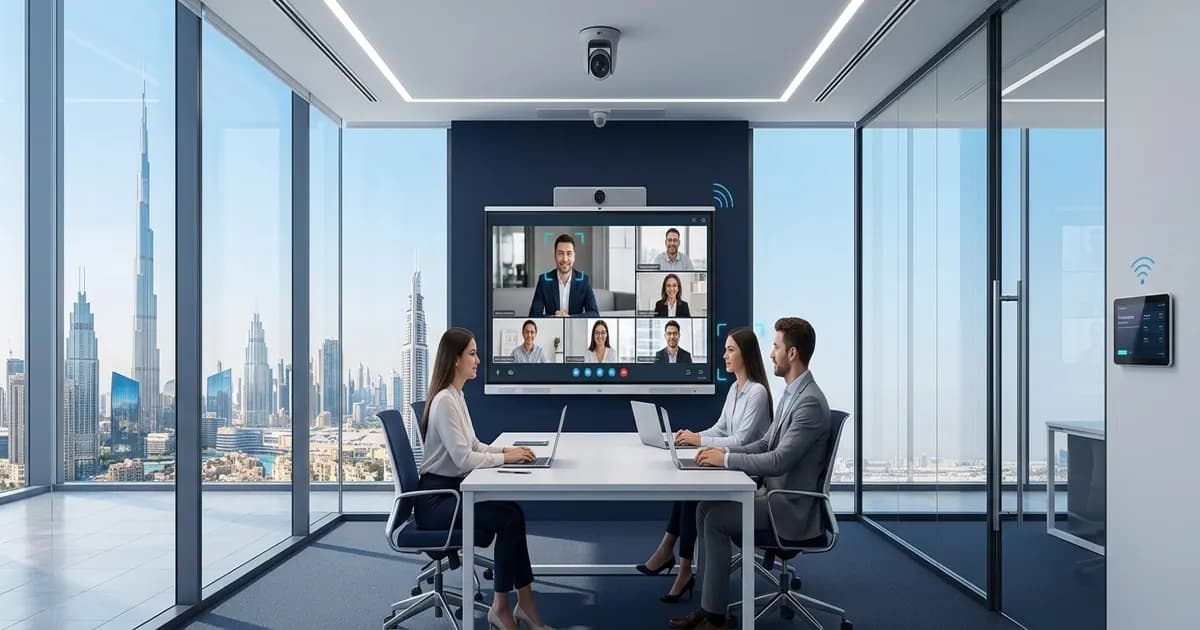
Effective hybrid meeting room solutions address this by combining high quality cameras that frame in-room participants naturally, professional microphones that capture audio clearly from anywhere in the room, multi platform compatibility that supports Microsoft Teams, Zoom, Cisco Webex, and Google Meet, and one touch meeting start controls that remove technical barriers. When designed correctly, hybrid meeting rooms make remote participants feel present and engaged, not distant and disconnected.
The Role of Wireless Presentation Systems
One of the simplest improvements a business can make to its meeting rooms is removing cables from the content sharing process. Wireless presentation systems allow anyone in the room to share content from their own device instantly. There is no need to find an adapter, plug in a cable, or switch inputs on the display manually.
These systems support BYOD environments where employees use their own laptops and devices, and they integrate with room displays, video conferencing systems, and collaboration platforms. For businesses that host clients or external partners, wireless presentation creates a professional, seamless impression that reflects well on the organisation. Explore the full range of technology solutions available to understand how these technologies can work together in your meeting environment.
Why Audio Quality Matters in Modern Meeting Rooms
Research consistently shows that poor audio quality is the number one complaint in meeting room experiences. Even with high definition video, meetings break down when participants cannot hear each other clearly. Investing in professional microphone systems, acoustic room treatment, and intelligent audio processing delivers a measurable improvement in meeting quality.
Beamforming microphones track individual voices across a room and filter out background noise automatically. Distributed speaker systems ensure audio playback is consistent throughout the space. Acoustic panels and room design reduce echo and reverberation. Together, these elements create an audio environment where every voice is heard clearly, whether participants are sitting at the table or joining from a remote location.
How to Choose the Right Video Conference Solutions
Selecting the right video conference solutions for your business requires careful evaluation of several factors. Use the checklist below as a starting point:
• Room size and layout: Larger rooms require wider camera angles, more microphones, and higher output speakers.
• Number of participants: Solutions should scale comfortably from small huddle rooms to large boardrooms.
• Hybrid meeting requirements: Ensure the system supports equal participation for in-room and remote attendees.
• Audio and video quality: Prioritise systems with high definition video and professional grade audio processing.
• Platform compatibility: Verify compatibility with Microsoft Teams, Zoom, Cisco Webex, and other platforms your organisation uses.
• Wireless connectivity: Look for integrated wireless presentation capabilities to reduce cabling and simplify content sharing.
• Ease of use: One touch meeting start controls reduce friction and improve adoption across teams.
• Scalability: Choose systems that can grow with your organisation and integrate with future technologies.
• Integration and support: Work with a technology partner who can manage installation, configuration, and ongoing maintenance.
Why Businesses in Dubai Are Adopting Smart Meeting Room Solutions
Dubai and the wider UAE are undergoing a significant digital transformation. The UAE's National Digital Economy Strategy and Smart Dubai initiatives are driving widespread adoption of connected workplace technologies across both public and private sectors. Businesses operating in Dubai are responding to a workforce that expects modern, technology-enabled work environments.
Smart meeting room solutions in Dubai are part of a broader movement toward intelligent workplaces that support productivity, collaboration, and operational efficiency. Companies with distributed teams across the UAE, the GCC region, and global markets need reliable, high quality meeting room technology that supports seamless communication across time zones and locations.
The Future of Meeting Room Technology
The next generation of modern conference room technology will be driven by deeper AI integration, more intelligent automation, and tighter cloud connectivity. Meeting rooms will become data rich environments where sensors, cameras, and room management systems work together to optimise space utilisation, energy efficiency, and collaboration quality.
AI powered meeting assistants will handle scheduling, pre meeting briefings, in meeting note-taking, and post meeting follow up automatically. Advanced wireless presentation will support 8K content sharing and multi room collaboration. Cloud managed AV systems will allow IT teams to monitor, update, and troubleshoot meeting room technology remotely without on-site visits. For businesses planning workplace technology investments, understanding these trends is essential for making decisions that remain relevant over the next five to ten years.
Conclusion: Build Smarter Meeting Rooms for a Connected Workforce
Meeting room solutions are no longer about hardware alone. They are about creating intelligent collaboration environments that connect employees, customers, partners, and remote teams in a seamless and productive way. The combination of AI powered video conferencing systems, smart room automation, wireless presentation, professional AV, and intelligent room management defines what a truly modern meeting room looks like in 2025 and beyond.
Businesses that invest in the right technology today will gain measurable advantages in collaboration quality, employee experience, and operational efficiency. Vega Digital helps organisations across Dubai and the UAE design and implement complete smart meeting room solutions tailored to their specific needs. Connect with our technology experts to explore the right meeting room solution for your business and start building a workspace that supports how your teams actually work today.
Frequently Asked Questions
What are meeting room solutions?
Meeting room solutions are integrated combinations of video conferencing systems, wireless presentation tools, interactive displays, smart room controls, and AV equipment. They are designed to support seamless collaboration for both in-person and remote participants, creating a connected and productive meeting environment for modern businesses.
What is a smart meeting room?
A smart meeting room uses automation and intelligent technology to simplify the meeting experience. Displays, cameras, microphones, and lighting activate automatically when a meeting starts. One touch controls allow participants to begin meetings instantly without manual configuration, improving efficiency and consistency across all meeting spaces in a facility.
What is a video conferencing system?
A video conferencing system combines cameras, microphones, speakers, displays, and software to enable real time audio and visual communication between participants in different locations. Modern systems support AI powered features like automatic speaker tracking, noise cancellation, and real time transcription, making virtual meetings more productive and engaging for all participants.
What are the benefits of modern conference room technology?
Modern conference room technology improves collaboration quality, reduces meeting setup time, supports hybrid participants equally, and simplifies content sharing. Businesses benefit from better communication, higher employee engagement, more efficient use of meeting spaces, and scalable technology infrastructure that grows with their organisation over time.
How do wireless presentation systems work?
Wireless presentation systems allow participants to share content from their laptops, tablets, or smartphones to the room display without cables or adapters. They connect via Wi-Fi or dedicated wireless protocols, supporting multiple devices simultaneously, reducing meeting friction, and supporting BYOD environments common in offices with upgraded wireless infrastructure.
What are the benefits of wireless presentation systems for offices?
Wireless presentation systems eliminate cable clutter, reduce meeting setup time, and allow any participant to share content instantly. They support multiple platforms and devices, improve meeting flexibility, and create a professional impression for clients and visitors. Businesses using reliable office networking infrastructure get the most consistent wireless presentation performance.
Why are hybrid meeting room solutions important?
Hybrid meeting room solutions ensure remote participants have an equal experience to those in the room. High quality audio, intelligent cameras, platform compatibility, and wireless presentation all contribute to meeting equity. Without purpose built hybrid technology, remote attendees often feel disconnected, reducing engagement and the overall value of the meeting.
How is AI changing video conferencing?
AI is transforming video conferencing through automatic speaker tracking, intelligent camera framing, background noise cancellation, real time transcription, meeting summaries, and action item generation. These features reduce administrative burden, improve meeting quality, and make recordings more useful. Businesses adopting integrated communication systems benefit most from AI enhanced collaboration capabilities.
How do businesses choose the right AV solutions for meeting rooms?
Businesses should evaluate AV solutions based on room size, participant capacity, hybrid meeting needs, audio and video quality, platform compatibility, ease of use, and scalability. Working with an experienced technology partner who understands room acoustics, system integration, and ongoing support requirements helps ensure the right solution is selected and properly implemented.
What are the latest meeting room technology trends for 2025?
The latest trends include AI powered video conferencing, smart room automation, wireless presentation systems, interactive flat panel displays, hybrid meeting solutions, intelligent room booking, and cloud managed AV infrastructure. Businesses investing in smart automation technologies are also applying similar principles to create more intelligent and responsive meeting environments